Showing posts with label africa safari. Show all posts

Thursday, June 11, 2020

All About Zanzibar

Zanzibar is an archipelago of historic Indian Ocean islands, awash with atmosphere, intrigue and idyllic beach experiences. It has a wide range of accommodation choices and plenty to see, do and discover. The island is the perfect place to relax after an exciting safari or after conquering Kilimanjaro. It is also a paradise for honeymooners or a romantic holiday getaway. As the site of Sultans’ palaces and renowned for its spice plantations, the little island republic of Zanzibar is a must-see for any visitor to Tanzania.

Zanzibar is an archipelago located 23-miles from mainland Tanzania. When you arrive there, you might as well be in a different country because while it is officially part of the country, in almost every way - politics, religion, culture, food - life there is different.

As a base for traders from the the Arabian peninsula, the African Lakes region and India, Zanzibar became a hub for the region’s slave and spice trades. Most locals consider themselves Zanzibari rather than Tanzanian, and the territory has its own leader and governing bodies. Tanzania has a mixture of Christian, Muslim, and indigenous groups, but Zanzibar itself is almost completely Muslim.

GETTING TO ZANZIBAR

Most travelers get to Zanzibar by airplane from Arusha or any of the small airstrips in the national parks. If you’re traveling from Dar Es Salaam you can also take a boat. Depending on where you are boarding the plane, a flight usually takes about 1-3 hours in a bush plane. If you depart from Dar es Salaam by high-speed boat (four times a day each way), it takes about two hours, and tickets are cheap.

STONE TOWN

Visitors to Zanzibar tend to arrive and leave via Stone Town, a historic historic hub for commerce and culture within Zanzibar City. This ancient center was the seat of the Sultans, whose crumbling palaces, bath houses and mosques are a legacy of this opulent and vibrant time at the heart of the gold trade. Stone Town remains a wonderful place to spend a night or two, getting lost among the ancient buildings and labyrinthine streets and its ancient spice markets, eating fresh fish on the sea front, and breathing in the sights, sounds and smells of a true Swahili center.
Stone Town was declared a UNESCO cultural heritage site in 2000. It’s charming, but it can sometimes be a challenge to navigate. There are street names, kind of, but no one really uses them. However, on the bright side, Stone Town is small and safe, and not knowing where you’re going is part of the adventure and experience. The locals are helpful, so feel free to ask for directions as many times as you want, but sometimes it’s better to just go with it and let yourself get lost.


FOOD IN ZANZIBAR

Over its history Zanzibar has had many rulers and its long, tragic history is responsible for one of Africa’s most interesting cuisines. A tasty mash-up of Indian, Arab, Chinese, Portuguese and African cooking traditions, all driven by the constant presence of spice (these are known as the Spice Islands, after all, where cloves, cinnamon, black pepper and nutmeg come straight from the source.), this is the original fusion food! Be sure to sample African ugali, Indian chapatti, Swahili curries, and eat as much of their fresh seafood as possible. Keep an eye out for specialties like octopus curry and urojo, a turmeric and coconut-based soup with crispy fritters and spiced potatoes that seems to have the island’s entire history contained within its broth. If you want to try to reproduce these recipes when you get home, head to the Darajani market at the main Bazaar, where the locals shop – but get there early, before the weather gets too hot.

ZANZIBAR CULTURE

In Zanzibar, life moves slowly (pole pole in Swahili). Things don’t always make sense, they don’t always work, or they can take a while so it’s better to enjoy the calm chaos and unhurried pace. Your smoothie might take 45 minutes to appear, but rest assured it will be delicious and well worth the wait.
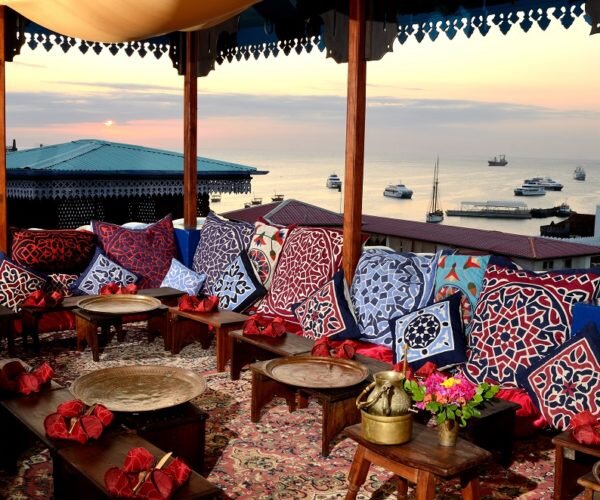
In Zanzibar, you’re allowed to drink, and it’s also permissible to wear beach clothes in the right places. Having said that, there are times and places when neither is appropriate. For example, skimpy clothing and overdoing the alcohol while Stone Town is best avoided. There are bars in Stone Town, and you can also drink in tourist and expat restaurants or in the fancier hotels in town or on the coast, but you should remember that your waiter probably does not drink, so be patient and kind if their wine-bottle opening isn’t as graceful as you’re used to. There are only a couple stores in Stone Town that sell alcohol, and it’s a good idea to bring your own bag so you’re not seen with a bottle of gin or vodka on the streets.

Drinking is not just for beach bars and rooftops - the local tea scene is a great way to meet people that live on the islands. Most tea stands or carts start serving once the sun has gone down so be sure to try the tangawizi (ginger) chai and, if possible, add vanilla. Taking a mug of hot and spicy tea to the side of a road is a fun way to people watch. If you’re in Stone Town, ask for the nearest Babu Chai, and someone should be able to point you in the right direction.

Taraab music, from Arabic tariba (‘to be moved’), blends African, Arabic and Indian influences. Typically, a Taraab orchestra combines Western and traditional local instruments, including an accordian, a violin, a kanun, a nay and drums, plus a singer. You’ll find these groups playing at different venues around Stone Town.

NIGHTLIFE IN ZANZIBAR

When you first arrive, Stone Town can seem scary at night. The dimly-lit narrow streets and back alleys aren’t really inviting to people prone to aimless wandering. But don’t let the travel advisories for extra caution after nightfall keep you in your room. Stone Town’s nightlife is bustling, with kids playing, couples strolling, and people feasting everywhere. The centrally located night market, Forodhani Gardens, is jam packed with locals and tourists tasting the many fresh food stalls. Avoid the skewers of shellfish, which may have been sitting out in the sun all day, and instead go for grilled Indian spiced chicken and Zanzibar pizza with fresh sugar cane juice.

DIVING AND OTHER WATER SPORTS

Tanzania is known for its amazing safaris, but Zanzibar is not the Serengeti. Here, the wildlife is all underwater. With reefs surrounding the islands, Zanzibar is a prime destination for diving. The water temperatures are warm, visibility is typically excellent, the currents are weak and there’s a great abundance of colorful fish, all of which makes for an ideal location for beginner divers. On the North and East coasts, many of the larger resorts have professionally-run dive shops on-site. Please note that qualified divers must produce their certification and a log book.
If you make it to the islands, try and visit one of the many centers offering scuba diving training courses, and views of the coral and Indian Ocean life. But please take note that overfishing and lack of environmental oversight have damaged many of Zanzibar’s best reefs. Some of the best snorkeling can be found on Chumbe Island, a protected marine park about a ten-minute drive and 45-minute boat ride out of Stone Town.
If you’re not interested in diving you can go sailing on a dhow cruise, or try your hand at kayaking, snorkeling, waterskiing, windsurfing, parasailing, jet-skiing, kiteboarding and other water activities.

WEATHER IN ZANZIBAR

Just like the mainland, Zanzibar has two rainy seasons. Every year, there are the long rains and the short rains. On the heels of the hot East African summer, Zanzibar’s long rainy season lasts roughly from March until May. Booking a trip during this period if you’re set on a beach holiday will give you less tourists but you will very likely experience some rain. The short rains generally take place between November and December, but aren’t nearly as intense—they tend to show up in short and torrential bursts, then quickly fade back to blue skies.

WHERE TO STAY IN ZANZIBAR

Zanzibar has a handful of East Africa’s most luxurious resorts, which can be a bit jarring in contrast to what is an otherwise quiet and poor island (the average local earns less than $1 a day). If you’re looking for a beach escape with other Westerners, you should head north to Nungwi and Kendwa, where you’ll find the same all-inclusive packages you’d find in most other warm parts of the world. It is a busy area with a bustling nightlife. For a more Zanzibari experience, check out quieter towns like Paje or Jambiani where the rhythms of village life will mix with your slice of island paradise.

5 RANDOM FACTS ABOUT ZANZIBAR:

  1. Zanzibar is not a single island; it’s a group of islands just off the coast of East Africa. The two large main islands are Pemba and Unguja. Unguja is sometimes incorrectly referred to as “Zanzibar”. 
  2. The Anglo-Zanzibar War between the Zanzibar Sultanate and the United Kingdom on August 27, 1896 lasted only 38 to 45 minutes before there was a ceasefire. This makes it the shortest war in history.
  3. The lead singer of Queen, Freddie Mercury, was born in Zanzibar in 1946. His birth name was Farouk Bulsara.
  4. In 1973 Zanzibar was the first country in Africa to have color television. 
  5. Zanzibar is called The Spice Islands because its main economic activity, after tourism, is spice exports – primarily, nutmeg, cloves, cinnamon and black pepper. 

Tuesday, April 7, 2020

A Luxury Safari in Tanzania: Review of Sababu Safaris

LINDA D.   // NEW YORK, NY
OCTOBER 2019

Beyond incredible! Sababu is purposeful, personal, and genuine.

If you're looking for an incredible safari and a genuine visit to Tanzania, Sababu Safaris is your guide.

We  wanted to to go through a company that was eco-conscious and  responsibly connected to the country and people of the area. We wanted  our money to go to someone who cared about the animals, the land, the country, and the people of Tanzania. Sababu is genuinely that, and so  much more.

But before I talk about how wonderful the safari was,  what an amazing guide the co-founder Robert is, and how seamlessly easy Denise makes all the planning...

I have to first talk about how Sababu helped us visit the child we sponsor through Compassion  International. We've sponsored a child with Compassion for many years.  And while Compassion organizes group trips and approves individual visits to your child, it's been too complicated and expensive of a process to seem feasible to us. When we realized our safari would take us close to where our child lives, we talked with Compassion and Sababu.  Compassion has their own paperwork and background checks for visit approval. But after that, there are many logistics to figure out:  meeting up with the Compassion International guide/interpreter, setting times with the Compassion Center leaders, and setting up the home visit with the child and family. Sababu took care of all of this for us. They truly went above and beyond. We know for sure that this visit would not have been possible without them. Robert took care of all of the logistics on the Tanzanian side. He worked with Compassion International  directly to make everything smooth for us—so that we could focus solely on visiting our child (rather than all the details surrounding it).  Sababu also helped us find out what our child's family and the local Compassion center needed so that we were able to take personalized  gifts. While Compassion International has general recommendations,  Sababu talked to the local Compassion center for us directly for  specific needs. This visit with our sponsor child was the most beautiful experience of any trip we've ever had. Robert worked out all the details and helped translate the language and the cultural differences while we were visiting with the family—and both Robert and Mohamed (who  was driving for Robert that week) were active, respectful, and kind participants in the visit. They engaged with the family and created an atmosphere for us to have quality and deep connection with our sponsor child and family.

Now on to all the other wonderful safari details!

Sababu makes planning a breeze. We were planning a last minute trip—we planned it only three weeks out! But Denise and Robert helped us create our dream itinerary without compromising any of our priorities. Denise made the planning so simple. She is quick to respond. And she easily guided us through our millions of questions to find the right plans for us.

They work to make it a truly personalized experience. In our first conversation, Denise asked about our priorities. When I told her we wanted to maximize the amount of days we had in Tanzania over the luxury  of the accommodations, she found a way to add three days to our  itinerary while staying within our budget! And that still had us staying at incredibly nice camps with luxury amenities. Sababu gave us options  and helped us achieve all our priorities within our price range.Robert is an amazing guide. He truly loves and knows the animals and the bush—and that passion shows. He is such a joy to be around. He shares his knowledge and experience of the animals and of the communities in Tanzania. He caters each day to what you want to see. He takes you to remote areas of Serengeti that a lot of the big companies won't go to—because he cares more about seeing the animals than about saving the gas mileage. Within just a day, we considered Robert a friend. He is so kind and genuine. And as we went to visit different projects and tribes,  Robert also guided us through those experiences—sharing about the people and the history and helping us to engage and connect well.

The animals! Listen, you will not find a more up-close, in-the-wild experience than you will with Sababu. I can't even begin to talk about this without writing twelve pages. You will NOT be disappointed.

We visited Plaster House in Arusha. We took a solar light to the Datoga tribe. And we visited the Hadzabe huntsmen. All of these experiences were amazing and meaningful. I could write so much about each of them.  But the best thing I can advise is that you talk with Denise about these  projects as you plan your trip. She can work to make it fit well into your itinerary, and she can guide you toward the ones that might work best for you and those you are traveling with.

Denise and Robert suggested that we end our stay at Africa Amini Maasai Lodge. If you can do this, you absolutely should! It's a beautiful and relaxing way to end the safari and reflect on your time. And it's a meaningful way to  get to know the Maasai as they share their culture and stories. They also have a school, orphanage, and healing center that are doing incredible work. While you stay at the lodge, you can take an afternoon to visit and learn more about these projects.

I could say so much more. But let me just end with saying you can't go wrong with choosing  Sababu. They will help you plan a safari that is not only the once-in-a-lifetime dream safari, but that connects you to the people and the animals in a meaningful, life-changing way. #travelwithpurpose

Tuesday, March 24, 2020

Tanzania Safari Reviews and Testimonials: Sababu Safaris


LORETTA M. // LONDON, UK
February 2020

From start to end, a perfect personally tailored adventure close to the heart of Tanzania! We have just returned from our amazing 6 days private safari with Sababu.  From the very beginning when planning our trip, Denise at Sababu was a pleasure to deal with, quick and on-point to reply to us, prompt to answer all of our questions and offering great expert insights on what would suit us best according to our budget and expectations. We felt part of the family from the start.
Sababu Safaris testimonials
We chose Sababu exactly for that, to go beyond the big corporate Safari groups and be closer to the heart of Tanzania, its nature and its people, too.

The itinerary tailor-made for us was just perfect, the suggestions offered on accommodation and the well planned out days were just a perfect balance between adventure and some more relaxed times. Each day was different with the complete option to change our schedule if and when we felt the need to.

Robert (our guide) was an incredible source of information on all aspects of the animals and their habitat! He is such an experienced and incredible guide. He was always happy to answer all of our questions about the wildlife and the many questions we had on the history of Tanzania and Africa. He was an absolute pleasure to spend time with and we learnt so much from him and shared many laughing moments together.

We felt extremely safe all along our trip and the amazing off-road experiences we had. Rob knew where to go and when to go to show us the best places to see the animals and incredible  scenery. We saw all the animals we wanted to and got some incredible photos as Rob knew where to locate them all. We couldn’t have asked for a  better guide and company. Thank you Rob sincerely for making our safari so special and we will always remember our fun time together; we had an adventure and fulfilled our life time dream of doing a Safari.

The ethical conscious approach of Sababu gave us the opportunity to contribute back to the country we visited, too. During our Safari we visited a Masai village and handed out solar lights which was an unforgettable experience.

SABABU and their team gave us the trip of our lifetime. Their eco-conscious ethic and friendly approach was beyond welcoming to a country which will always be in our hearts. We are very glad to have chosen Tanzania for our first Safari, an amazing country with such amazing nature from the Serengeti to the Ngorongoro Crater to the sandy beaches of Zanzibar, and we can not recommend enough to others that they should use SABABU, as they travel with a purpose and bring an adventure to your bucket list! Go for it, as you will not regret it!!

Friday, February 14, 2020

Things To Do In Arusha Before and After Your Safari In Tanzania


The vibrant town of Arusha is more than just a gateway to Tanzania’s ‘Northern Circuit’. It actually has a lot to offer travelers who are willing to spare the time. Many international travelers often opt to stay in Arusha just long enough to overcome the initial jetlag before heading to the likes of the Serengeti, Ngorongoro, and Tarangire or Lake Manyara. But for those who choose to linger a little longer before or after their safaris, Arusha does offer a surprising number of things to do, such as:

TAKE A TOUR OF SHANGA WORKSHOP
This bustling, interactive workshop is one of a kind and dedicated to empowering the local community by employing people with disabilities to create unique, high-quality items like handmade jewelry, glassware, woodwork, and decorative homeware. For these people, Shanga offers more than a new lease on life, but also a community of passionate and ambitious individuals. Spend time with them, hear their stories, watch them do their work with incredible skill and maybe even try to craft something yourself. A visit to Shanga can comprise your choice of free workshop tours, activities, information sessions and shopping. It’s all part of the Shanga experience. This free visitor destination is open every day from 9 AM - 4.30 PM so you are welcome to stop by anytime or make an advanced booking if you are arriving as a large group.

School of St. Jude


VISIT THE SCHOOL OF ST. JUDE
The mission of The School of St Jude is to educate disadvantaged, bright students from the Arusha District to become moral and intellectual leaders in their country. The School of St. Jude is a bubbling place teeming with bright smiles and an array of fun school-based activities. A visit here gives you the opportunity to participate in a school-based itinerary offering a variety of activities - whilst not impacting the day-to-day education of the students: Sample traditional lunch with the students, visit interactive art, music, PE or library classes or attend a weekly assembly (on specific days only) and watch dance and music performances. You get to see first hand the impact that people from all over the world have achieved together and how that has resulted in a school of three highly resourced campuses changing the lives of 1,800 students, over 250 staff and their families. Should you choose, make a donation to make a small difference in the lives of the students.

LEARN ABOUT TRADITIONAL AFRICAN CUISINES
You can attend a cooking class here in Arusha and gain a deeper appreciation of how local ingredients and spices are skillfully combined to make delightful dishes. You’re in Tanzania for an adventure of a lifetime and it is only fitting that your palate experiences a scintillating journey of its own. By the time you return to your home country, you’ll have more than exciting memories and photographs as mementos of your trip, but also practical knowledge of how to put new kinds of dishes together.

Cooking Class

GO ON A COFFEE TOUR
Arusha is surrounded by coffee plantations, so a cup of steaming fresh coffee is never far away. Meander across coffee estates as you learn how pretty flowers transform into rich brown beans that make up one of the world’s most consumed beverages. A coffee tour in Arusha also lets you stock up on fresh coffee beans that you can take home. One of the best-known coffee sites, Arusha Coffee Lodge, is actually the location of the Shanga workshop so you can cross off two items of this list with a single tour.

CHECK OUT LAKE DULUTI
Lake Duluti lies inside a volcanic crater and is located about 20 minutes from Arusha. This crater lake has water year-round thanks to groundwater and seasonal rainfalls. Here you can go canoeing or hike around the crater. The marsh area of the lake is home to humongous papyrus plants and you will usually spot different varieties of colorful bird species.

EXPERIENCE THE NIGHTLIFE
If you would like some nightlife action before or after your safari, don't worry, Arusha’s got you covered. There are several places to go, including sports bars, night clubs, karaoke, and even big-screen movie parties. It all depends on your mood for the night.

VISIT THE CULTURAL HERITAGE CENTER
This is the place to be if you are looking to get a closer glimpse of Tanzania’s rich culture through art and artifacts. The eclectic design of the building alone makes it one of the more popular visitor destinations in Arusha. Step in and be wowed by the beautiful wildlife sculptures and amazing exhibits that tell the story of Tanzania and its people. There are also items for sale if you’re inclined to contribute to the ever-growing artistic expressions of the community.

Personalize your Arusha experience with Sababu Safaris today!
At Sababu Safaris, we are committed to providing you with more than a travel package, but a personalized itinerary that lets you travel with purpose and make a lasting impact on the local communities that you visit. Call us today at +1 914-207-4426 or fill out our contact form to get started.